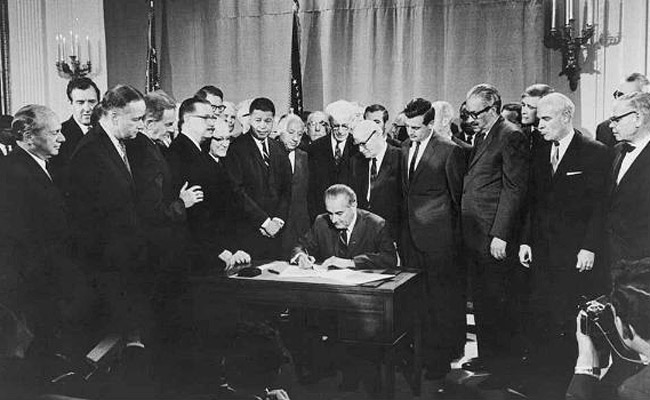
 Title VIII (the “Federal Fair Housing Act”) of the Civil Rights Act of 1968, signed by President Johnson a week after the assassination of Martin Luther King Jr., advanced the struggle for integration taking place in Cleveland’s eastern suburbs and elsewhere across the nation.
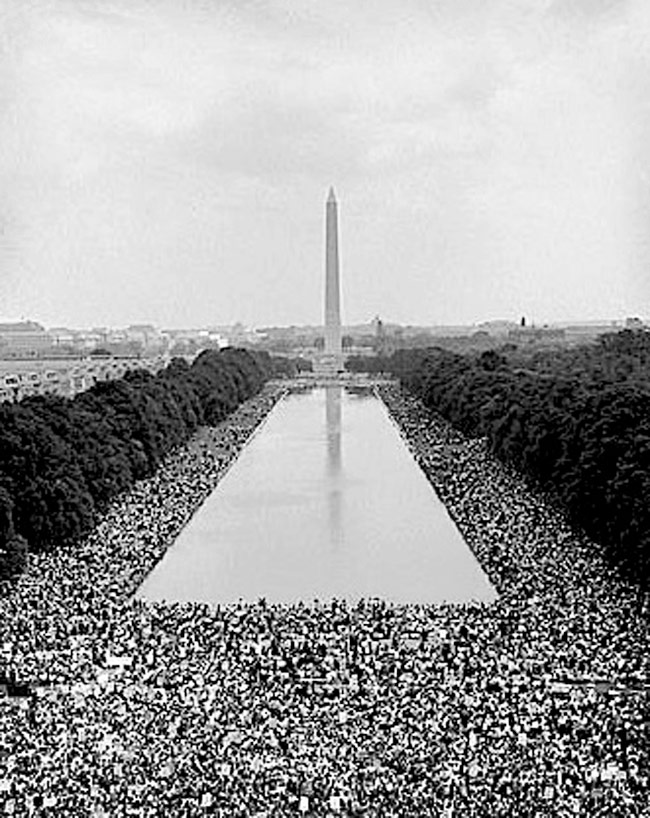 The March on Washington, August 28, 1963, at which Martin Luther King Jr. called upon the nation to make good on democracy’s promise of social and economic freedom for all citizens
 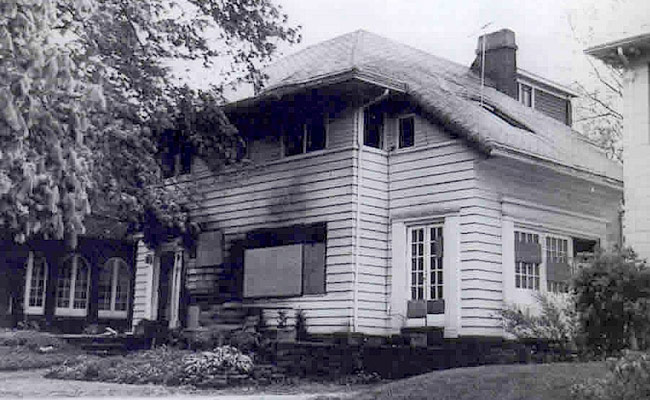 In 1967, this Cleveland Heights home, owned by an African American, was bombed in a senseless and vain attempt to halt the suburb’s integration.
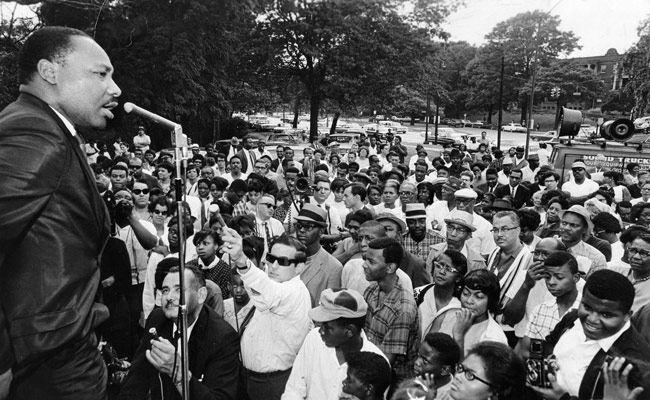 Dr. King speaking in Rockefeller Park on a visit to Cleveland in 1967. The previous year he had dramatized the issue of housing discrimination by moving his family into a grimy apartment on the segregated west side of Chicago and joining in protest marches into that city’s all-white neighborhoods.
The Cleveland Foundation began to address the issue of housing segregation in the early 1960s, making grants to support the Ludlow and Moreland neighborhood associations that sprang up to encourage the integration of neighborhoods straddling the boundaries of Cleveland and the inner-ring eastern suburb of Shaker Heights. Thus began the foundation’s longstanding commitment to promoting fair housing and integration.
In 1960, only one of every 40 minority families in Cuyahoga County lived outside the City of Cleveland. Most people accepted the status quo. It required courage on the foundation’s part to lend moral and financial support to a wide range of groups working to overturn entrenched patterns of housing segregation. In addition to neighborhood associations, grantees included the Fair Housing Council, which successfully lobbied municipalities across the county to pass fair housing resolutions in the mid-1960s, and the Heights Community Congress (HCC), a broad-based coalition of organizations and individuals that monitored the progress of integration in the inner-ring eastern suburb of Cleveland Heights. When warranted, HCC took remedial action to maintain racial balance and harmony, filing lawsuits against local realtors, for example, that set standards for nondiscriminatory treatment of African-American home buyers.
Cleveland also participated in Operation Equality, a Ford Foundation demonstration project to improve minority housing opportunities in eight test cities. The willingness of the Cleveland Foundation and its affiliated Greater Cleveland Associated Foundation to match a Ford grant of $180,000 allowed Operation Equality to open four field offices in Cleveland in 1966–67. Field workers provided assistance to African-American families willing to risk buying homes in white neighborhoods. Having helped to relocate 200 African-American households during its first two years, Operation Equality-Cleveland decided to shift its focus from providing services to individual clients to attempting to bring the real estate industry into compliance with federal fair housing provisions passed as part of the 1968 Civil Rights Acts. The Cleveland office joined with the U.S. Department of Justice to file fair housing suits against several area apartment management firms in the early 1970s that resulted in consent agreements governing more than 10,000 units.
Progress toward integrating the city’s eastern suburbs became noticeable. By 1970, one of eight African-American households lived outside Cleveland’s boundaries. As outward migration continued, Shaker Heights, Cleveland Heights and University Heights were faced with the prospect of resegregation—that is, they were well on their way to making the transition from all-white to all-minority. Rather than ignoring these demographic trends, municipal and public school officials formed the East Suburban Council for Open Communities (ESCOC) in 1983 with the support of the Cleveland Foundation.
ESCOC offered low-interest loans from special-purpose funds established in Shaker and Cleveland Heights to home buyers willing to settle in neighborhoods where their race was underrepresented. In 1988, the integration maintenance program received an Innovations in State and Local Government Award, one of 10 presented by the John F. Kennedy School of Government at Harvard University that year. Funded by the Ford Foundation, the award recognized ESCOC as the “nation’s first public-private inter-jurisdictional approach to integration, targeting affirmative marketing to all home seekers on a sub-regional rather than local basis.” Equally important, the organization had helped to slow resegregation in the Heights and maintain the racial diversity that is a prized attribute of the area today.